Authoritative simulation
The server owns state. Clients send intent, the tick resolves truth. Deterministic RNG with seeds keeps runs reproducible.
tick p50 37.8 ms
Aurkad 1.0 · open source · Apache-2.0
The open-source engine for multiplayer 2D games. Paint the map, write the rules and open the doors: players join from a browser, on desktop or phone, on a server you own.
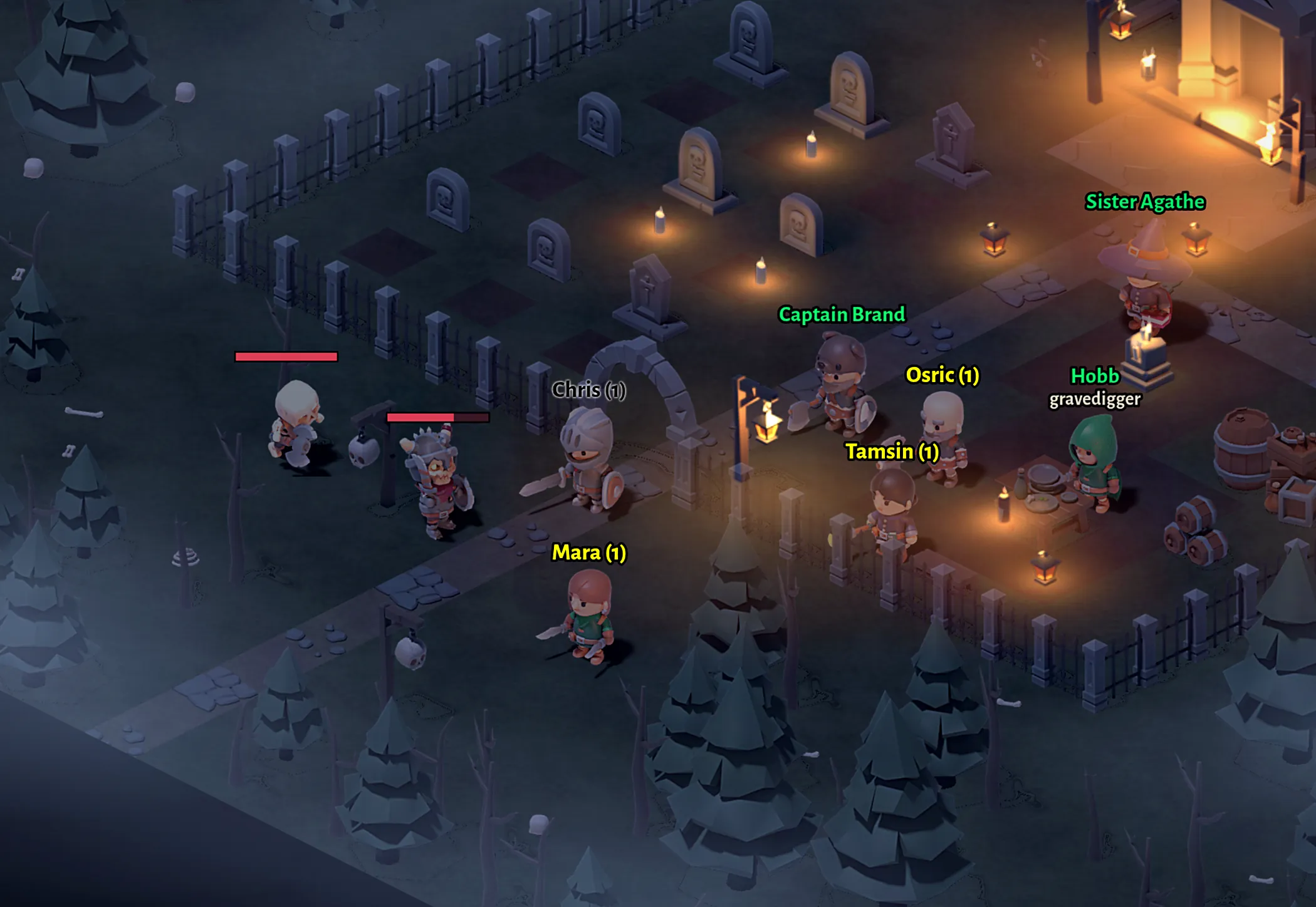
Captured in-engine
01 / Engine
The parts that usually kill an MMO project are the ones Aurkad treats as core infrastructure.
The server owns state. Clients send intent, the tick resolves truth. Deterministic RNG with seeds keeps runs reproducible.
tick p50 37.8 ms
Differential snapshots, hot/cold tiers, entity-level replication, quadtree AOI and viewer-specific cadence.
websocket · AOI
Write systems in JavaScript or TypeScript against a typed API, with hot reload while the world keeps running.
typed · hot reload
Quests, guilds, magic, trade, crafting and more ship as optional modules over a small, strict core.
25 official modules
Deterministic replay, audit trail, feature flags, schema versioning and backup/restore for real live-ops.
replay · audit trail
No-code editors for maps, items, NPCs, quests, loot, dialogs and the game's look, plus a script editor and an admin panel, all in the browser.
10 content types
Load harness in the repository. Bots and server share one machine, so these figures are a floor.
02 / Architecture
Your game sits on top of optional modules, which sit on top of a strict authoritative core. Each layer can be replaced without touching the one below.
Content, scripts, maps, rules: everything specific to the world you ship.
maps · quests · scripts · assets · theme · balance
Official gameplay systems you enable, replace or ignore.
guilds · trade · magic · party · crafting · lighting
Networking, authoritative simulation, persistence, replication, live-ops.
netcode · sessions · AOI · persistence · observability
03 / Modules
25 official modules. Enable what your world needs; everything here is optional and replaceable.
Live-ops
Observability
Data & security
Scale & reach
04 / Get started
Three commands from an empty folder. Docker pulls the engine, the first start writes a small playable game into game/, and the world is up.
Download one compose file, generate a playable starter game and bring it up with Docker. No clone, no build. Health and readiness endpoints report when the world is live.
Paint orthogonal or isometric maps, wire quests, tune loot tables, write dialogs and restyle the UI through no-code editors that talk to the running instance.
Express behaviour in typed JavaScript or TypeScript against the engine API, then hot reload without dropping sessions.
# bash or zsh, from an empty folder$curl -LO https://github.com/christianaurichzm/aurkad/releases/latest/download/compose.yml$echo "ADMIN=yourname" > .env$docker compose up -d
# PowerShell, from an empty folder. With WSL, the Linux commands work as they are.PS>curl.exe -LO https://github.com/christianaurichzm/aurkad/releases/latest/download/compose.ymlPS>Set-Content .env "ADMIN=yourname"PS>docker compose up -d
Then open https://localhost and register the admin name you chose. Requires Docker with the Compose plugin. On a server, point a domain at it and Caddy fetches a real certificate.
05 / Origin
I want Aurkad to help people turn a subject they care about into an online world others can enjoy.
Christian Aurich Zanettini Martins · Creator of Aurkad
In 2008, when I was 8, I wanted to turn my imagination into an online world others could explore. Many MMORPGs I played were pay-to-win; as a kid with no money for games, that frustration gave me another reason to create my own.
I started with Elysium Diamond and Eclipse Origins, engines written in Visual Basic 6. The editor was enough to make a game, but I wanted features in the core, so I opened the source. Eventually, I wrote my own VB6 engine, ran a server and led its community.
Years later, already working as a Lead Software Engineer, I returned to my old engine as a hobby and a test of what I'd learned. Over two years, I rebuilt it around work and other projects: VB6 on Windows gave way to TypeScript, containers and browser clients over WebSocket, with authoritative simulation and maps distributed across server instances.
The name
Aur comes from Aurich, my surname, and aurum, Latin for gold. Kad echoes arcade.
Free and open source under Apache-2.0. Your maps, art, scripts and modules carry no obligation from the license: keep them closed and sell them.
Support, integration or a custom module? contact@aurkad.com